

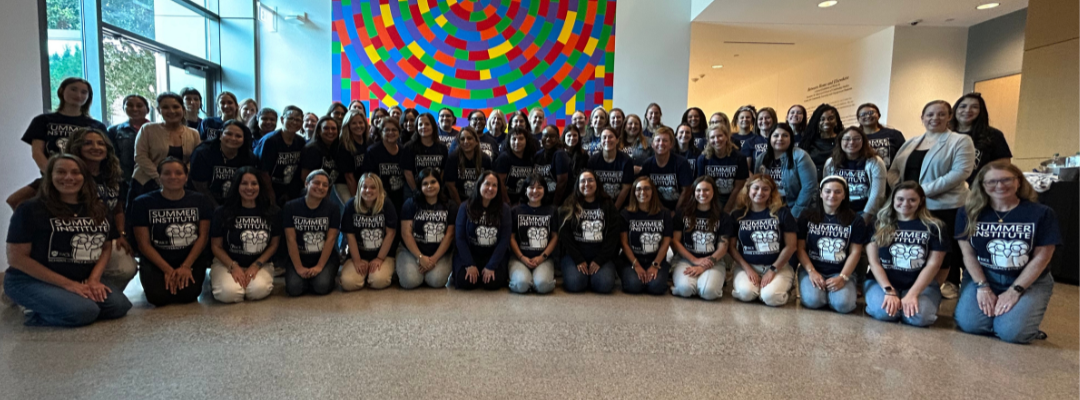
Nearly 60 early childhood educators from across the Greater Houston area gathered at Rice University July 21-24 for the Susanne M. Glasscock School of Continuing Studies’ annual Summer Institute on Reading, Writing and Cultural Connections. Hosted by Rice’s acclaimed School Literacy and Culture (SLC) program, the four-day intensive institute offered pre-K through first-grade teachers a collaborative space to rethink classroom practice, examine new educational research and take home hundreds of actionable strategies for the upcoming school year.
Held at the Anderson-Clarke Center on the Rice campus, the institute delivered 30 professional development hours designed to bridge the gap between academic research and daily classroom instruction. Through interactive workshops, expert-led presentations and peer discussions, participants explored key topics ranging from foundational language acquisition to socio-emotional learning and culturally responsive teaching.
“The Summer Institute is so much more than traditional professional development; it is an opportunity for educators to pause, reflect and re-energize their teaching philosophies in a community that deeply values their work,” said Jordan Khadam-Hir, director of School Literacy and Culture. “By grounding our work in research-based practices while honoring the lived experiences and cultural backgrounds of every child, we empower teachers to build early learning environments where language, literacy and community truly flourish.”
Translating research into joyful classroom practice
At the heart of this year’s institute was the challenge of translating cutting-edge cognitive and linguistic research into practical, joyful classroom routines. Early childhood educators often face the complex task of balancing high-stakes literacy standards with developmentally appropriate practices. The SLC Summer Institute addressed this balance directly, offering sessions focused on strengthening essential building blocks — including oral language development, phonological awareness and alphabet and print knowledge — without sacrificing creativity or play.
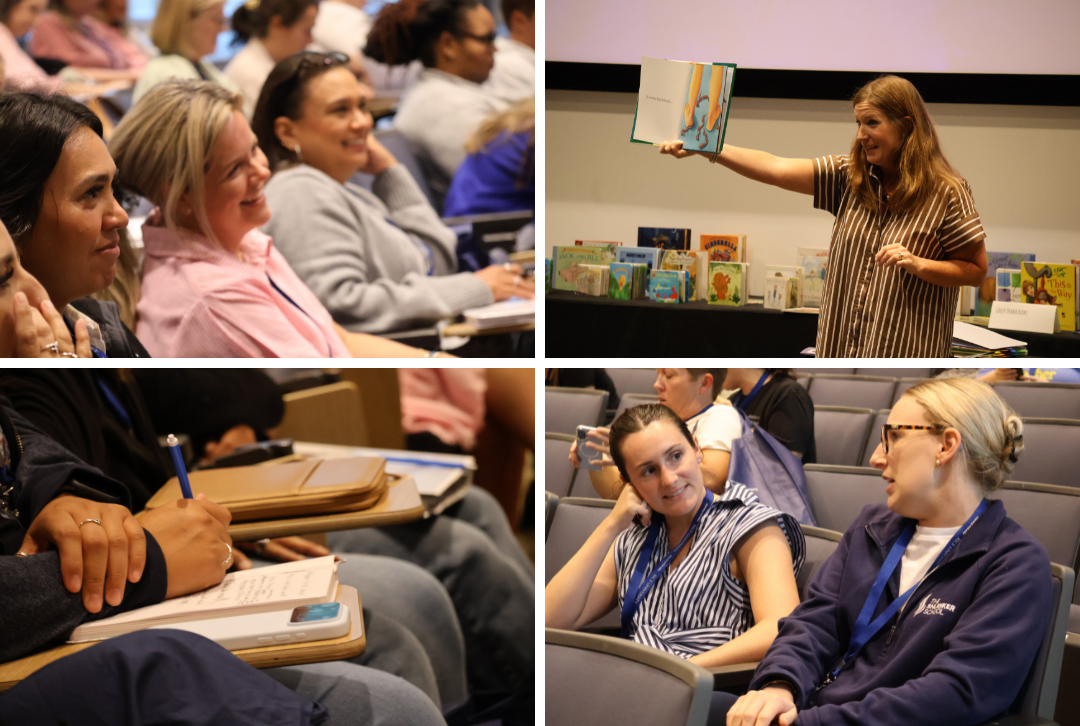
A signature cornerstone of the SLC model featured prominently throughout the four days: storytelling, dictation and dramatization. Inspired by the pioneering work of early childhood educator Vivian Paley, the approach encourages young learners to dictate their original stories to teachers, who transcribe them word-for-word before bringing the narratives to life on a classroom “stage” with peers acting out the roles.
Participants explored how story dictation acts as a powerful bridge between spoken language and written literacy. When young children see their spoken thoughts captured on paper and performed by classmates, they gain crucial insights into narrative structure, vocabulary and symbolic representation, laying a strong foundation for future reading comprehension and writing confidence.
Supporting the whole child and honoring home cultures
Beyond technical literacy mechanics, the institute emphasized the broader ecological picture of early childhood education: the socio-emotional development of young learners and the quality of teacher-child relationships. Workshop facilitators highlighted how emotional security, executive function and self-regulation skills serve as vital prerequisites for academic growth.
Central to these discussions was the imperative of bridging the gap between children’s home lives and school environments. In Greater Houston, one of the most culturally and linguistically diverse metropolitan areas in the United States, classrooms reflect a rich mosaic of languages, traditions and family structures. The institute provided educators with practical frameworks to integrate students' home cultures into daily literature choices, oral storytelling and classroom discussions.
“When children see their identities, languages and family traditions reflected in classroom stories and daily routines, literacy shifts from an abstract academic task to a deeply meaningful, empowering experience,” Khadam-Hir noted. “Connecting home and school cultures isn’t just an addition to the curriculum — it is the bedrock of inclusive, high-impact early education.”
Building a lasting network of educator-leaders
For decades, the Susanne M. Glasscock School of Continuing Studies has served as an essential pipeline for educator development and community outreach across Texas through its Center for Education, home to School Literacy and Culture. The Summer Institute on Reading, Writing and Cultural Connections represents one of SLC’s core initiatives, alongside its yearlong teacher leadership and mentoring programs, short courses and summits.
Attending teachers expressed appreciation for the opportunity to step away from summer preparation and engage in high-level professional dialogue on Rice’s campus. Working in small groups, educators shared district-specific insights, analyzed classroom case studies and discussed implementation strategies for lessons learned throughout the week.
Feedback from this year’s cohort highlighted the immediate value of both the research-backed strategies and the collaborative campus environment:
- “What I liked best about this Summer Institute was that all the sessions were divided and very organized based on the teachers' and students' needs to be successful in the future.” — Teacher, Vardeman EC/PK/K School
- “This was fantastic. Reading/books/literacy is my passion. This program is my jam.” — Teacher, West Memorial Elementary
- “I loved seeing actual student work and the setup of activities. It really helped me see how to put it into action in the classroom.” — Teacher, Rummel Creek Elementary
- “You all are amazing! Thanks for all the knowledge.” — Jones EC/PK/K School
- “I had a great time and learned so much valuable information!” — Teacher, The Schlenker School
- “You all are so amazing and so informative. I have learned so much and have left with more confidence as an educator.” — Teacher, Deer Park ISD ECC
- “I wish every teacher had a chance to attend. Thank you for being so passionate about early childhood education.” — Teacher, Ninfa Lorenzo EEC
The collaborative atmosphere fostered connections that extend far beyond the four-day institute. By bringing together teachers from public school districts, charter networks and private early childhood centers across Houston, SLC continues to nurture a vibrant, supportive network of educators committed to educational excellence.
As these nearly 60 educators return to their respective campuses this fall, they carry with them new pedagogical tools, research-backed strategies and a renewed passion for early literacy. For Rice’s School Literacy and Culture program, the summer institute reaffirms the university's enduring dedication to supporting local schools and enriching the lives of Houston’s youngest learners.
To learn more about Rice’s School Literacy and Culture, visit: literacy.rice.edu.