

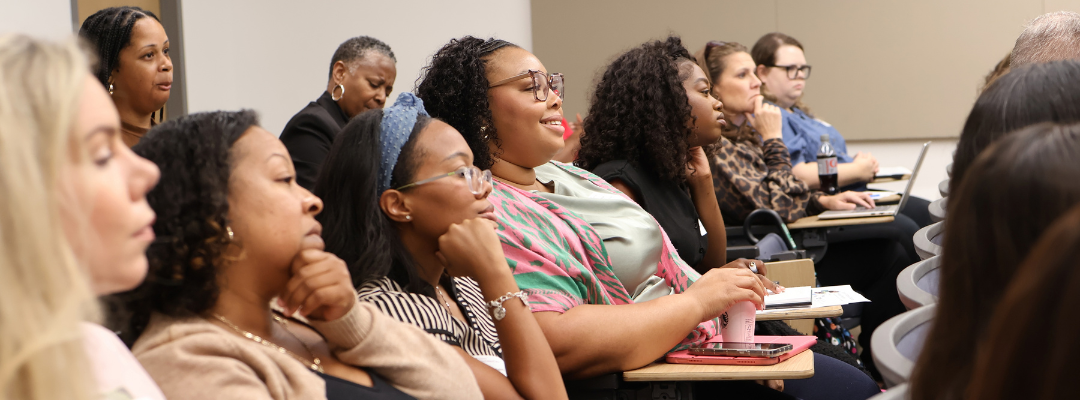
Rice University’s School Literacy and Culture (SLC), part of the Susanne M. Glasscock School of Continuing Studies’ Center for Education, convened more than 60 Houston-area principals, administrators, educators and early childhood experts for its annual Early Childhood Leadership Summit on Oct. 2, 2027.
Designed to equip educational leaders with research-based instructional strategies and practical implementation tools, the summit provided a vibrant space to explore early childhood pedagogy, interactive learning, oral language development and leadership in primary education.
A Foundation for Early Literacy and Leadership
The School Literacy and Culture program at Rice has spent over three decades advancing early childhood education across Greater Houston. Grounded in the belief that strong oral language skills and play-based learning form the bedrock of long-term academic success, SLC works closely with teachers and campus leaders to translate educational research into active classroom practice.
The Early Childhood Leadership Summit serves as a focal point for this mission, gathering leaders to reflect on systemic challenges, share effective methodologies and revitalize their instructional and leadership practices.
“Early childhood is the most crucial window for human development, and the leaders overseeing these programs — along with the educators in the classrooms — are doing some of the most complex, high-stakes work in education today,” said Jordan Khadam-Hir, director of School Literacy and Culture. “The summit is designed not only to deliver innovative, evidence-based leadership and instructional strategies, but to honor both campus administrators and educators as leaders who deserve dedicated space to learn, collaborate, reflect and elevate their practice.”
Participants underscored the value of having a dedicated forum tailored specifically to early childhood leadership and learning. Joel Bruff, Assistant Elementary Division Head of The Shlenker School, noted his appreciation for "The opportunity to learn in community with my peers while also gaining skills I can use to support my teachers and the important work they do."
Keynote Address: Rethinking Early Childhood Environments
The summit opened with an informative keynote address from Flávio Cunha, Ph.D., director of the Center for Economic Mobility, Ervin K. Zingler Chair of Economics and Department Chair, Economics, Rice University. Cunha shared findings from a multi-year partnership with a local school district focused on early school readiness, exploring what it takes to move from identifying a need to building a sustainable, evidence-based program that a district can carry forward.
Participants noted the unique opportunity to hear from an economist, appreciating not only the depth of research and the unique perspective on early childhood education, but also the clarity around incorrect assumptions at the project's outset and how the work pivoted as lessons were learned.
"It was amazing to see an economist passionate about ECE (early childhood education),” said Christy Dulaney, co-director of St. Luke's Day School. “Thank you for the Keynote."
Kari O'Connor, director of the School for Little Children, echoed that appreciation, stating, "I could have listened to Dr. Cuhna for another hour! Relevant research - distilled and presented is incredibly helpful."
Breakout Sessions: Translating Research into Practice
Following the opening address, attendees transitioned into interactive breakout sessions designed to tackle specific areas of early literacy, classroom management and instructional leadership. Led by SLC specialists and veteran educational leaders, these small-group workshops provided actionable strategies that participants could implement immediately on their campuses.
Breakout topics spanned a wide range of essential early childhood practices, including:
- The Science of Learning in Early Childhood: Principles, Practice and School-Wide Implementation
- Seeing What Matters: Authentic Assessment and Observation in Early Childhood
- Building Capacity Through Empowering Conversations
- Bringing the Vision to Life: Systems for High-Quality Early Childhood
Throughout each workshop, facilitators emphasized hands-on, active learning, encouraging participants to analyze real classroom scenarios, consider alternative classroom instructional approaches to enhance instructional effectiveness and student learning outcomes and draft implementation plans for their campuses.
Participant Perspective
- "It was illuminating, affirming & challenged some of my current beliefs & practices. Takeaways: 1. More PLAY! 2. More active [Learning] 3. Research [about] the science of learning 4. Create opportunity for more discourse." — Anjuli Crouch, KIPP Explore
- "I really enjoyed all the research-based information and that all the leaders presenting had early childhood experience/knowledge to share with us." — Christian Gonzalez, YES Prep Public Schools
- "The speakers had knowledge about the topics & had been teachers/principals in the past. It helps keep things in perspective." — Jennifer Garcia-Cortez, Helms Elementary, HISD
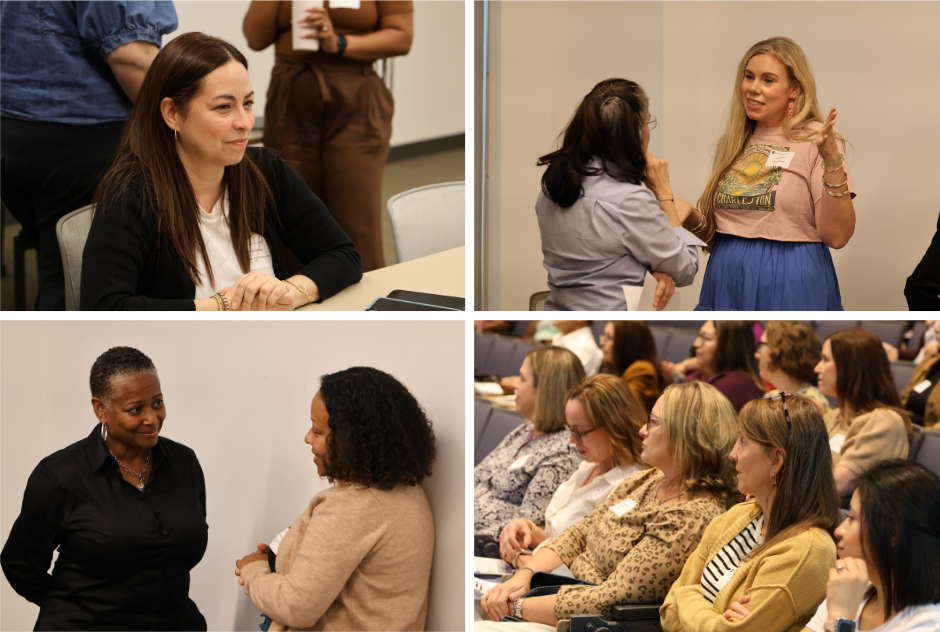
Panel Discussion: Leading Through Change in Early Education
The summit concluded with a dynamic panel discussion featuring district administrators, campus leaders and early literacy experts. The panelists addressed the evolving landscape of early education, navigating topic areas such as balancing standardized curriculum demands with developmentally appropriate play, supporting teacher retention and advocating for early literacy resources.
Panelist
- Erin Baumgartner, Ph.D. — Director, Houston Education Research Consortium, Rice University Kinder Institute for Urban Research
- Altagracia Delgado — Director, Texas Initiatives for the English Learners Success Forum
- April Falcon-Blanco — Director, Pre-K and Early Childhood, Spring Branch ISD
- Ashley Mejia — Head of Early Childhood and Lower School, Annunciation Orthodox School
- María Nevárez-Solís — Principal, Farias Early Childhood Center, Houston ISD
Panelists shared honest insights on the challenges facing school leadership today, while offering hopeful models of success from local schools that have prioritized play-based learning, developmentally appropriate practice, and innovative approaches to literacy instruction.
Donada Mayberry, a participant from KIPP Nexus Primary, noted her appreciation for the panel discussion, saying, "I got a lot of ideas from the ladies on the panel that I will take back to my school."
Overcoming Budget Constraints Through Community Sponsorship
In an era of increasingly tight school budgets, professional development for educators and administrators is often among the first line items to face reductions. Recognizing this challenge, the Glasscock School worked to ensure that top-tier training remained accessible to local educators despite growing fiscal constraints.
Through a generous sponsorship from CenterPoint Energy, the Glasscock School offered reduced tuition for attending educators and school district representatives, significantly lowering financial barriers and enabling broader regional participation.
“At the Glasscock School, we are deeply committed to making Rice’s educational resources accessible across our region, especially to the dedicated leaders shaping our youngest learners,” said Robert Bruce, dean of the Glasscock School of Continuing Studies. “When school budgets are squeezed, professional development opportunities are frequently cut short. Committed sponsors like CenterPoint Energy make it possible for us to bridge that gap, opening Rice’s doors to educators who bring these vital insights directly back to their classrooms and communities.”
Sustaining Impact Beyond Campus
As the participants left Rice’s campus, the impact of the Early Childhood Leadership Summit was already beginning to take shape in schools across the Houston area. By equipping educational leaders with evidence-based tools and connecting them with a supportive network of peers, SLC continues to nurture a stronger future for the region’s youngest students.
“When we invest in early childhood leaders, the positive ripple effect extends to hundreds of classrooms and thousands of children,” Khadam-Hir said. “Thanks to our partnership with CenterPoint Energy and the dedication of our attending leaders, we are building a vibrant community committed to ensuring that every child receives a joyful, language-rich foundation for learning.”
To learn more about Rice’s School Literacy and Culture, visit: literacy.rice.edu.