


Bringing together K-12 leaders, district administrators and university representatives from across the region, Rice’s Center for College Readiness (CCR) hosted its District Partners Fall Meeting on Sept. 15. Part of the Susanne M. Glasscock School of Continuing Studies, the center organized the gathering around the theme "From Synergy to Strategy: Targeted Solutions," focusing on sustainable strategies to drive advanced academic success amid shifting educational landscapes.
The meeting provided a platform for area district leaders to review updates to the Advanced Placement (AP) and International Baccalaureate (IB) programs, learn about Rice’s holistic admissions process directly from university enrollment leaders, and share best practices for sustaining rigorous academic opportunities.
David Johnston, director of the Center for College Readiness, highlighted the strategic imperative of deep collaboration between higher education institutions and local school systems.
“Our partnership with local school districts is at the core of everything we do at the Center for College Readiness,” Johnston said. “When university leaders and district administrators come together in a spirit of open dialogue and shared purpose, we can build direct pipelines of opportunity for students. By aligning our professional development with the real-world needs of area classrooms, we ensure that educators are supported and that every student, regardless of background, has access to the rigorous coursework that prepares them for college success.”
Spotlighting District Innovation
A key highlight of the event was the "Spotlight District" presentation featuring Tom Le, Ed.D., director of advanced academics at Pasadena Independent School District. Le shared how Pasadena ISD has successfully expanded its AP participation and score performance while navigating post-pandemic enrollment and resource constraints.
“We try to lead with evidence and empathy,” Le said. “The data is clear: students who score a 2 on an AP exam outperform their peers in college persistence and completion because they've learned to navigate intellectual challenges. We share this consistent messaging to all stakeholders, from administrator meetings to district-wide teacher staff development to parent meetings and student competition events. When teachers see former students return to say, 'AP taught me I could handle hard things,' mindsets begin to shift gradually but surely.”
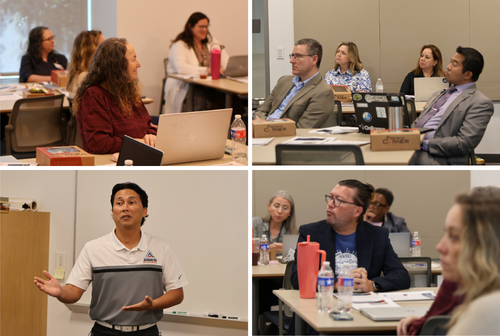
Le also detailed how Pasadena ISD relies on strategic adaptation and high-quality training to expand opportunities despite broader demographic shifts.
“Constraints sharpen strategy,” Le noted. “We will need to focus on efficiency and creative solutions. This may mean adding virtual AP courses to sustain offerings even in smaller schools, creating self-study courses in our learning platform Canvas for courses like AP Spanish Language and Culture or AP African American Studies, and ‘double-stacking’ courses with lower student counts into one period (like AP Computer Science Principles and Computer Science A). We're also focusing on course retention, ensuring that every student feels supported both academically and emotionally. If students do not drop an AP course this year, they will be more likely to take another AP course next year. Declining district enrollment is a challenge, but it's also a call to make every seat, every course and every opportunity count even more.”
For district leaders, the gathering offered crucial community support and actionable strategies.
“I was in a fog in my first year leading the district, but with the help from networks like Region 4 and Rice’s District Partners meeting, the fog began to be lifted, and the path vision became much clearer,” Le added. “Pioneering can feel lonely, and gatherings like this remind us that we are a part of a broader movement and that we can problem-solve similar challenges together. Here, we learn from each other's innovations, troubleshoot common obstacles, and leave with strategies we can implement the next Monday morning.”
Le praised the impact of Rice’s professional development programs on local educators: “From my own personal experiences, Rice sets the standard. Their AP Summer Institutes combine content mastery with pedagogical depth in a way that's unmatched. But beyond the training itself, Rice understands our context, they know our students, our region, and the unique challenges Houston-area districts face. When our teachers return from Rice, they come back not just with strategies, but with confidence and a network. We make Rice our first stop because we want our teachers to start with the best, and because partnership with a world-class institution like Rice sends this message to our teachers: ‘You ARE worth the investment!’”
Strengthening Regional Partnerships
The value of the network was echoed by leaders from Houston Independent School District (HISD), who pointed to the collaborative nature of the initiative.
“This network gives district leaders an opportunity to learn from colleagues facing similar challenges, share what is working and identify practices that can be adapted or scaled across districts,” said Sevasti K. Meloni, Director of Advanced Academics in HISD’s Division of College, Career & Military Readiness.
Meloni emphasized the role Rice plays in keeping professional development tailored to real-time classroom demands. “Having a responsive partner like Rice allows us to communicate the evolving needs of our teachers and helps ensure that the professional development available to HISD and other districts remains relevant and aligned to the work happening in our schools,” Meloni said. “Rice provides high-quality AP professional development led by experienced educators who understand both College Board expectations and classroom realities. That expertise, along with our longstanding partnership, makes Rice a valuable resource for investing in our AP teachers.”
Admissions Insights and Program Expansion
The fall meeting also featured a special presentation from the Rice Office of Enrollment. Vice President for Enrollment and Dean of Admission and Financial Aid Yvonne M. Romero, Executive Director of Admission Charles Murphy, and Director of University Relations Tamara Siler presented updates on Rice’s holistic application evaluation process, loan-free financial aid through The Rice Investment and how advanced coursework, such as AP and IB, is reviewed in admissions decisions.
Participants also received updates on upcoming Center initiatives, including Fall and Spring AP Saturday Workshops, the Fall IB Workshops, customized district professional development programs and the redesigned College Access Counseling Certificate program, which features four distinct tracks tailored for campus-based advisors, independent consultants, active professionals and parents.
Through ongoing partner meetings and the expansion of professional development offerings, the Center for College Readiness continues to reinforce Rice’s commitment to supporting K-12 educators and broadening college access throughout Greater Houston and beyond.
"When K-12 leadership and higher education work hand in hand, the entire educational ecosystem benefits," Johnston added. "Together, we are ensuring our teachers have the tools they need to inspire the next generation of college-ready scholars."
To learn more about Rice’s Center for College Readiness, visit: collegeready.rice.edu.